Many newer neighborhoods have covenants restricting outside antennas. These covenants have forced many hams to become very creative when installing HF antennas. Some hams are fortunate enough to be able to “hide” HF antennas behind trees, in trees, etc. However, most hams have to resort to installing antennas in the attic. The most common attic antenna is the dipole, as they are easy to install and work well. Other less common attic antennas are the loop and certain types of bidirectional beams.
This article details what I have learned after installing and using various types of antennas in my attic since 1986.
Dipoles
It did not take long to discover three things when attempting to install resonant dipoles:
- Attempting to install a resonant full-sized half-wave dipole can be a real problem. They cannot be cut to formula length and installed, since the attic environment (wiring, plumbing, vent pipes, insulation, etc.) detunes them, usually to a lower frequency. Retuning the dipoles in the confines of an attic can be a real chore. The problem can be compounded if one has to go down to the shack to check the SWR after each antenna length change.
- Where the antenna length must be reduced to fit the attic, coil loading must be used to maintain resonance. Not only does this present the tuning problems mentioned above, it also results in an antenna that has coil loss, matching problems and narrower bandwidth.
- If multiband operation is desired, either individual dipoles, with or without coil loading, or a multiband dipole with traps must be used. Either results in a lot of work and the problems mentioned above.
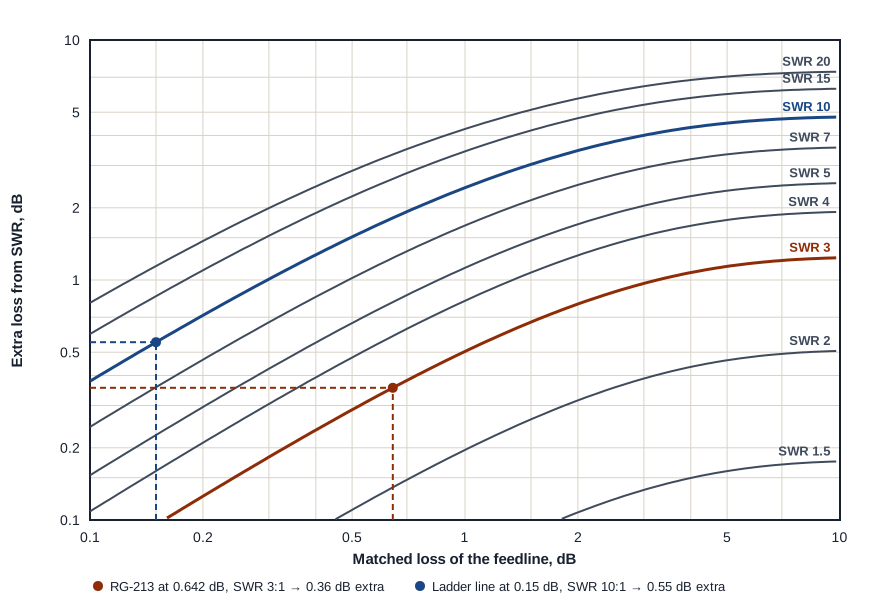
So, what is the best way to avoid the problems mentioned above and still have an efficient multiband attic dipole? Install a non-resonant dipole. Make the antenna as large as possible and feed it with either 450 ohm ladder line (available at HRO) or with a 4:1 balun and the best low-loss coax possible. Ladder line has virtually no loss no matter how high the SWR. Good low-loss coax will have a bit of loss depending on the frequency and the length of the coax. For example, Figure 1 shows that the loss of 100 feet of good RG-213 increases from about 0.6 dB to about 0.9 dB at 28 MHz when the SWR increases from 1:1 to 3:1.
Non-resonant dipoles will load with a good tuner. They will work very well on all bands above the antenna’s physical half wavelength and will work well on bands below the antenna’s physical half wavelength. For example, a dipole approximately 33 feet in length (a half wave on 20 meters) will radiate very well on 20 meters and above, and well on 30 meters and down. Depending on the size of the dipole, there may even be gain on the higher bands. For example, a 33 foot dipole will show some gain on 12 and 10 meters.
Loops
Loops work very well in attics. Their radiation pattern is hard to predict. The size and shape of the loop will determine the actual pattern. A loop has two advantages over a dipole. The loop will normally be somewhat quieter than a dipole. Also, they often will outperform a dipole due to their larger capture area. Just as with a dipole, install the largest loop possible and feed it with ladder line or very low-loss coax. Use a balun with the coax.
Some hams will install an auto tuner at the dipole or loop antenna’s feed point in the attic. This allows coax instead of “clumsy” ladder line to be used between the attic tuner and the ham shack. It also keeps the SWR loss close to that of ladder line.
Beams
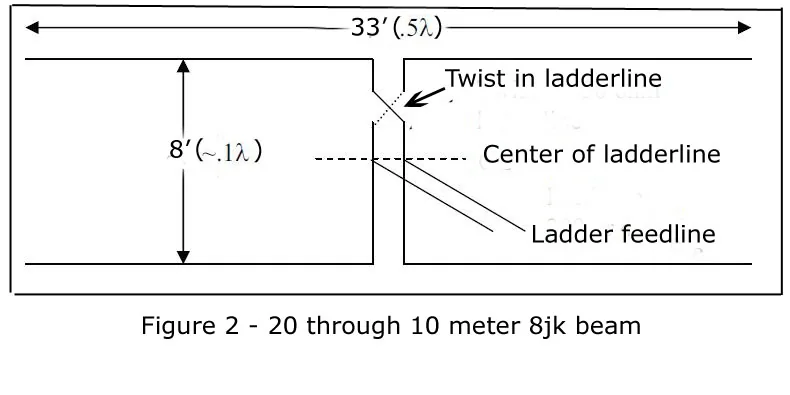
Beams in the attic are a problem, as there usually is no way to rotate the beam (and rotating the house isn’t an option!). Some hams may have room for a bidirectional wire 8JK HF beam (developed by W8JK). Figure 2 shows a typical 20 through 10 meter 8JK beam which would fit in most attics. As with a dipole, the wire lengths are not critical. They should be close to the wavelengths shown in Figure 2 for the lowest band to be used. The 8JK beam will load and work well with a good tuner on all frequencies above the lowest band for which it was designed.
Drawing: Bill Rinker, W6OAV
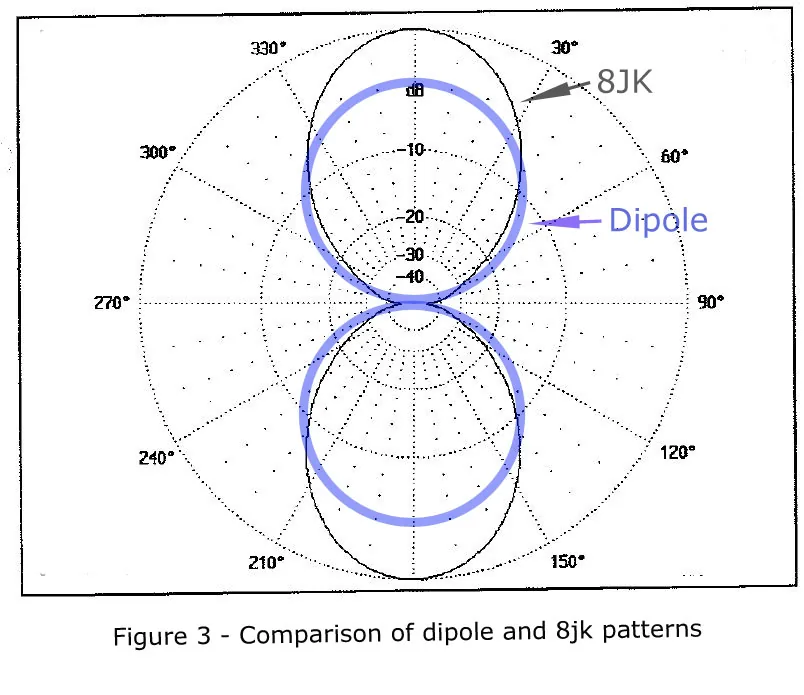
The 8JK has fairly broad figure-8 radiation lobes and a fair amount of gain. Figure 3 compares dipole and 8JK radiation patterns on 20 meters. The 8JK has about 4 dBd gain on 20 meters to about 6 dBd gain on 10 meters.
EZNEC plot: Bill Rinker, W6OAV
My Station Setup
My HF attic installation consists of a 35 foot dipole above a wire 8JK beam. The dipole and 8JK beam are fed with 450 ohm ladder line and a tuner. A remote controlled relay allows switching the ladder line between the two antennas. The dipole works well on 75 meters through 10 meters. The 8JK beam works well on 20 meters through 10 meters. Tests with remote stations comparing the dipole against the 8JK do indicate that the 8JK has about 4 dBd gain on 20 meters to about 6 dBd gain on 10 meters.
Both of my antennas physically run north and south, providing good coverage to the east and west. Keep in mind that antennas in a one story house will have a high angle of radiation. Antennas in a two story house will have a slightly lower angle of radiation. I’ve literally worked the entire world using 100 watts with these antennas in a two story house.
Gutter Antennas
As a side bar, hams have successfully loaded rain gutters.
Conclusion
As mentioned earlier, the SWR losses caused by ladder line and good coax are minimal. A popular misconception is that the power reflected by an antenna mismatch is absorbed by the tuner rather than being radiated. This is not true. The tuner will re-reflect the power back to the antenna, where it will be radiated. The only loss will be that caused by the ladder line or coax as described earlier. A very good mathematical and pictorial reference on this subject can be found in Reflections II by Walter Maxwell, W2DU. This reference also validates the material presented in this article.
In summary, do not spend time attempting to resonate an attic antenna. Just install the largest possible dipole or loop. Then feed it with 450 ohm ladder line or very good coax with a balun and a good tuner. Also, keep in mind that running more than 100 watts could be a safety issue. You don’t want to set your attic on fire!
Further Reading
- Reflections II, by M. Walter Maxwell, W2DU