Portable amateur radio has become one of the fastest growing areas of our hobby. Whether you’re activating a park for Parks on the Air (POTA), hiking to a summit for Summits on the Air (SOTA), operating during Field Day, or preparing for emergency communications, one thing is certain: your station is only as reliable as its power source.
Unlike operating from the home shack, portable stations depend entirely on batteries. Selecting the proper battery and understanding its capabilities can make the difference between hours of enjoyable operating and an early trip home.
Choosing the Right Battery
Today’s portable operators typically choose from three battery chemistries: sealed lead acid (SLA), lithium-ion (Li-ion), and lithium iron phosphate (LiFePO₄ or LFP).
Sealed lead acid batteries, including AGM and gel cell types, have powered portable stations for decades. They are inexpensive and widely available but are heavy, experience noticeable voltage sag under load, and should normally be discharged no more than about 50% to preserve battery life.
Lithium-ion batteries are considerably lighter and provide excellent energy density. They are commonly used in laptops, power tools, and handheld radios. While well suited for many applications, their higher cell voltage and thermal characteristics make them somewhat less desirable for directly powering amateur radio equipment. A fully charged four-cell lithium-ion pack reaches about 16.8 volts, above the limit of most radios.
LiFePO₄ batteries have become the preferred choice for most portable amateur radio operators. They are lightweight, provide a very stable output voltage (12.8 volts nominal, about 13.2 volts in use), offer long cycle life, and are among the safest lithium battery chemistries available. Their nearly constant voltage allows most HF and VHF radios to maintain full output power throughout the discharge cycle.
Initial Cost vs. Lifetime Cost
At first glance, sealed lead acid (SLA) batteries appear to be the least expensive option. Lithium-ion (Li-ion) batteries typically cost more than SLA batteries, while LiFePO₄ batteries generally have the highest initial purchase price. However, purchase price tells only part of the story.
A better measure of battery value is the total amount of useful energy it delivers over its service life. Sealed lead acid batteries typically provide only about 200 to 300 charge-discharge cycles and should normally be discharged no more than about 50% to maximize life. Conventional lithium-ion batteries generally deliver 500 to 1,000 cycles and allow approximately 80 to 90% of their capacity to be used. In comparison, quality LiFePO₄ batteries commonly provide 2,000 to 5,000 or more cycles while allowing about 90 to 95% of their capacity to be used.
As an example, at typical 2026 prices, a 20 Ah sealed lead acid battery costing around $60 provides about 10 Ah of usable capacity per cycle. Over 250 cycles, it delivers approximately 2,500 ampere hours of useful energy. A comparable lithium-ion battery may cost about $120 and provide approximately 17 Ah of usable capacity over 750 cycles, yielding roughly 12,750 ampere hours of lifetime energy. A similar LiFePO₄ battery may cost around $170 but provides about 18 Ah of usable capacity over 2,500 or more cycles, producing approximately 45,000 ampere hours of useful energy.
Although LiFePO₄ batteries have the highest initial purchase price, they typically deliver the lowest cost per ampere hour over their lifetime. Lithium-ion batteries fall between SLA and LiFePO₄ in both purchase price and long-term value. For operators who use portable equipment only occasionally, the lower initial cost of an SLA battery may still be attractive. However, hams who regularly participate in POTA, SOTA, Field Day, emergency communications, or other portable activities usually find that LiFePO₄ batteries become the most economical choice over the long term while also offering lower weight, excellent voltage regulation, and outstanding service life. See Table 1.
| Battery type | Typical purchase price (20 Ah) | Usable capacity | Typical cycle life | Approximate lifetime energy |
|---|---|---|---|---|
| Sealed lead acid (AGM/gel) | $50–70 | ~10 Ah | 200–300 | ~2,000–3,000 Ah |
| Lithium-ion (NMC/NCA) | $100–140 | ~16–18 Ah | 500–1,000 | ~8,000–18,000 Ah |
| LiFePO₄ (LFP) | $150–200 | ~18–19 Ah | 2,000–5,000+ | ~36,000–95,000 Ah |
Typical 2026 prices.
Selecting the Proper Battery Size
The best battery size depends on the radio, transmit power, operating mode, and the length of the activation. See Table 2.
| Radio | Receive | Transmit |
|---|---|---|
| QRP HF (5–10 W) | 0.3–0.6 A | 2–3 A |
| 50 W VHF/UHF mobile | 0.5–1 A | 8–12 A |
| 100 W HF transceiver | 1–2 A | 18–22 A |
Typical figures in 2026; check your own radio’s manual.
Fortunately, the average current is much lower than the transmit current because most operators spend considerably more time listening than transmitting.
As a rule of thumb:
- 4–6 Ah LiFePO₄ batteries are ideal for QRP operation.
- 10–20 Ah batteries comfortably support several hours of typical 100 watt HF operating.
- 30–40 Ah batteries provide all-day operation for Field Day, POTA activations, or emergency deployments.
Estimating Operating Time
A simple way to estimate operating time is to calculate the average current drawn by the radio.
For example, assume a 100 watt HF transceiver draws:
- 20 A while transmitting
- 1 A while receiving
If you transmit only 20% of the time, the average current becomes approximately:
(20 A × 0.20) + (1 A × 0.80) = 4.8 A
A 20 Ah LiFePO₄ battery could therefore operate the station for roughly four hours before reaching its recommended discharge limit.
Actual operating time varies depending on duty cycle, digital modes, transmit power, and battery age, but this method provides a useful estimate.
The Importance of the Battery Management System (BMS)
Nearly every quality LiFePO₄ battery includes an internal Battery Management System (BMS). This electronic circuit continuously monitors the battery and protects it from conditions that could shorten its life or cause damage.
A BMS typically provides:
- Overcharge protection
- Overdischarge protection
- Cell balancing
- Overcurrent protection
- Short circuit protection
Many modern batteries also include low temperature charge protection, preventing charging below freezing where permanent damage could otherwise occur.
Charging a Battery
LiFePO₄ batteries should be charged using a charger specifically designed for LiFePO₄ chemistry or one with a selectable LiFePO₄ charging mode. Unlike lead acid batteries, they require different charging voltages and charging profiles to maximize performance and battery life.
Although many modern “smart” chargers support multiple battery types, older automotive chargers designed only for lead acid batteries may not be suitable.
Wiring a Portable Station
Proper wiring is every bit as important as selecting the battery.
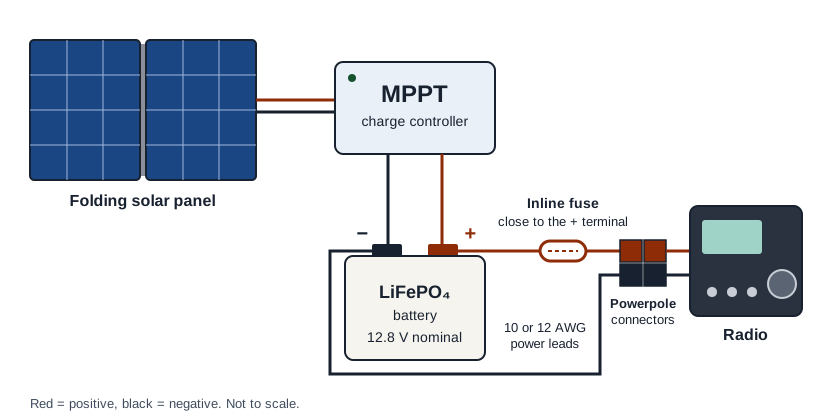
Use adequately sized power cables, typically 10 or 12 AWG for 100 watt HF transceivers (heavier for long runs), to minimize voltage drop during transmit peaks. Every battery should have a fuse installed as close to the positive terminal as practical. A properly placed fuse protects both the equipment and the operator if an accidental short circuit occurs.
Most amateur radio emergency communications groups have standardized on Anderson Powerpole® connectors because they are reliable, genderless, and interchangeable among equipment from different manufacturers.
Extending Operating Time with Solar Power
For multi-day activations or emergency deployments, a folding solar panel can greatly extend operating time. A 60–100 watt panel paired with a quality MPPT (Maximum Power Point Tracking) charge controller will often keep a 10–20 Ah LiFePO₄ battery fully charged during normal daytime operating. MPPT solar charge controllers harvest significantly more energy than simpler PWM solar panel controllers, particularly during changing sunlight conditions. With adequate sunlight, solar charging can allow a portable station to operate for days with little concern about battery capacity.
Cold Weather Performance
Cold temperatures affect every battery chemistry, but not equally. Lead acid batteries lose a significant amount of usable capacity as temperatures fall below freezing. LiFePO₄ batteries also experience reduced capacity in cold weather but generally retain considerably more usable energy and maintain a much more stable operating voltage. One important exception is charging. LiFePO₄ batteries should not be charged below freezing unless they include built-in low temperature charging protection or internal heaters.
Portable Battery Safety
Modern LiFePO₄ batteries are extremely safe, but a few simple precautions are worthwhile. Always protect battery terminals from accidental short circuits, use properly fused cables, avoid physically damaging the battery case, and store batteries in a cool, dry location when not in use. Before long trips, recharge the battery and verify that all power cables and connectors are in good condition.
Summary
For most portable amateur radio operations, LiFePO₄ batteries provide the best combination of light weight, stable voltage, long service life, and overall reliability. While sealed lead acid batteries remain useful for budget-conscious or fixed backup applications, LiFePO₄ technology has become the battery of choice for portable HF and VHF stations. See Table 3.
| Battery type | Voltage | Usable capacity | Typical cycle life | Relative weight |
|---|---|---|---|---|
| LiFePO₄ (LFP) | 12.8 V nominal (about 13.2 V in use) | 90–95% | 2,000–5,000+ | Light |
| Lithium-ion (NMC/NCA) | 14.4 V nominal (about 16.8 V fully charged) | 80–90% | 500–1,000 | Very light |
| Sealed lead acid (AGM/gel) | 12.0–12.6 V | 40–50% | 200–300 | Heavy |
By selecting the proper battery capacity, using safe wiring practices, and understanding how your station consumes power, you’ll spend less time worrying about batteries and more time enjoying the radio. Whether you’re activating a local park, climbing a mountain summit, operating Field Day, or supporting emergency communications, a dependable power system is every bit as important as the transceiver itself.