Key Points
- Between ground wave and the first skywave hop lies a skip zone, so stations an hour away can be the hardest to hear.
- NVIS sends the signal almost straight up, and it comes back down in a circle out to roughly 300 miles.
- It needs a low antenna: a horizontal dipole about a tenth of a wavelength up, around 25 feet on 80 meters or 12 feet on 40.
- 80 meters is the reliable night band and 40 meters the daytime workhorse. If close stations vanish, the band has gone long: move down.
- NVIS is a takeoff angle, not a mode, and it will not help on 20 meters or VHF.
Everyone starts out trying to work the world. Then a neighboring club asks you to join their evening net, or a weather emergency puts traffic on the air 80 miles away, and you find something odd: the station two states over is loud, and the one an hour’s drive away cannot hear you at all.
That gap has a name, and it has a fix.
Why the Close-In Contacts Are the Hard Ones
On HF, a signal that leaves your antenna at a shallow angle goes a long way before the ionosphere bends it back to earth — hundreds or thousands of miles. Between the few tens of miles your ground wave covers and the point where that first hop lands, there is a ring of country where almost nothing arrives. That ring is the skip zone.
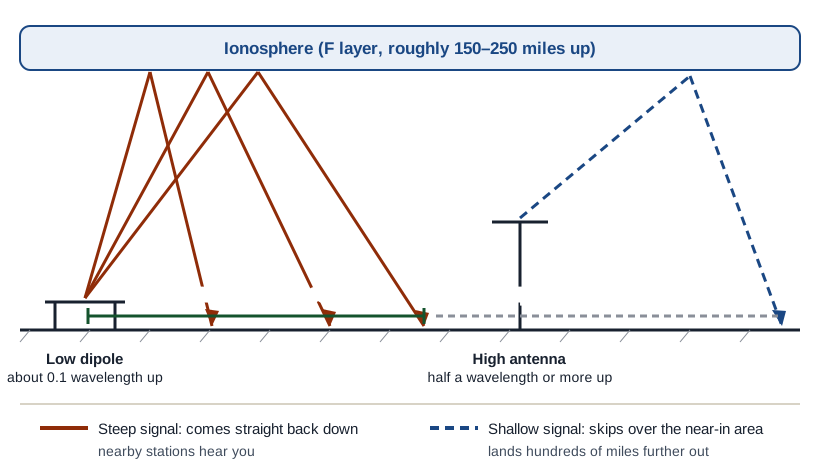
A tall, well-built antenna makes the problem worse, not better. Height is what gives you a low takeoff angle, which is exactly what you want for DX and exactly what jumps over your own region.
Near-Vertical Incidence Skywave
The answer is to aim almost straight up. Send the signal up at a steep angle and the ionosphere reflects it back down in a broad circle around you, filling in everything from your own town out to roughly 300 miles. Radio engineers call it near-vertical incidence skywave, NVIS for short. Emergency communicators lean on it heavily, because it needs no repeater, no internet and no infrastructure between the two stations.
For NVIS you want a LOW antenna. A horizontal dipole about a tenth of a wavelength above ground radiates most of its energy upward — around 25 feet up on 80 meters, 12 feet on 40. What looks like a badly installed antenna is the right antenna for this job.
The ground under a low dipole matters more than usual, because the reflection off it is part of how the pattern forms. Damp ground is better than dry. Some operators add a reflecting wire or two on the ground under the antenna, a quarter to a half wavelength long, and gain a little.
Picking the Band
A steep signal only comes back if the ionosphere is dense enough to reflect it at that angle. That limit is the critical frequency, and it changes through the day, the season and the solar cycle. In practice you learn two or three bands and move between them.
| Band | Best time | Notes |
|---|---|---|
| 80 meters | Night | The reliable night-time choice for 50 to 300 miles. Needs a long antenna, but it can be low. |
| 60 meters | Evening and night | Channelized in the US, with power limits, and an excellent short-path band between 80 and 40. |
| 40 meters | Day, into the evening | The workhorse daytime band for this distance for much of the year. |
| 30 meters | Day | Sometimes works close in when 40 has gone long, though it is CW and data only. |
Which band works depends on the critical frequency at the time, which rises and falls with the sun and the solar cycle. If signals from 100 miles away vanish, the band has gone long: move down.
The test is simple: call a station you know is 100 miles away. If they are weak or absent while stations 1,000 miles away are strong, the band has gone long and you should try a lower one.
Getting It Working
- A dipole for the band you want, hung as low as 10 to 25 feet, fed with coax and a choke at the feed point.
- Run it in any direction you like; at these heights the pattern is broad, and beam heading barely matters for a 100-mile contact.
- If you have room for only one wire, a doublet fed with window line and a tuner in the shack will do several bands at once.
- Do not raise it to “improve” it. If you also want DX, put up a second antenna rather than compromising this one.
What It Is Not
NVIS is not a magic trick and it is not a mode. It is a takeoff angle. It will not help on 20 meters, where the ionosphere usually will not return a steep signal at all, and it does nothing for VHF. What it does is close the one gap that surprises almost every new HF operator: the people nearest to you.