Key Points
- RF in the shack, an SWR that changes when you touch the radio, and noise that follows you around the dial usually have one cause: current on the outside of the coax shield.
- A common-mode choke blocks that current and leaves the wanted signal inside the cable alone.
- A useful HF feedline choke has at least 1,000 ohms of common-mode impedance; 2,000 to 5,000 ohms is better. One clamp-on bead is not enough.
- Put the choke at the antenna feed point, where the current gets on.
- Fix the cause first: a balanced, well-fed antenna with a choke at the feed point rarely needs anything else.
There is a family of complaints that all turn out to be the same fault. The linear trips on voice peaks. The SWR changes when you put your hand on the radio. Your own transmission comes back as a buzz in the speakers, or the neighbor’s doorbell chimes on 40 meters. Receive noise is high on every band and follows you around the dial.
Nearly always, the feedline has become part of the antenna.
Three Currents, Not Two
Coax is meant to carry two equal and opposite currents: one on the center conductor, one on the inside of the shield. They cancel, so the cable radiates nothing and hears nothing. That is the whole point of it.
But a shield has two surfaces, and the outside of it is a conductor in its own right. If the antenna is not balanced, or the feed point is not symmetrical, some current finds its way onto that outer surface and runs back down toward your shack. That is common-mode current.
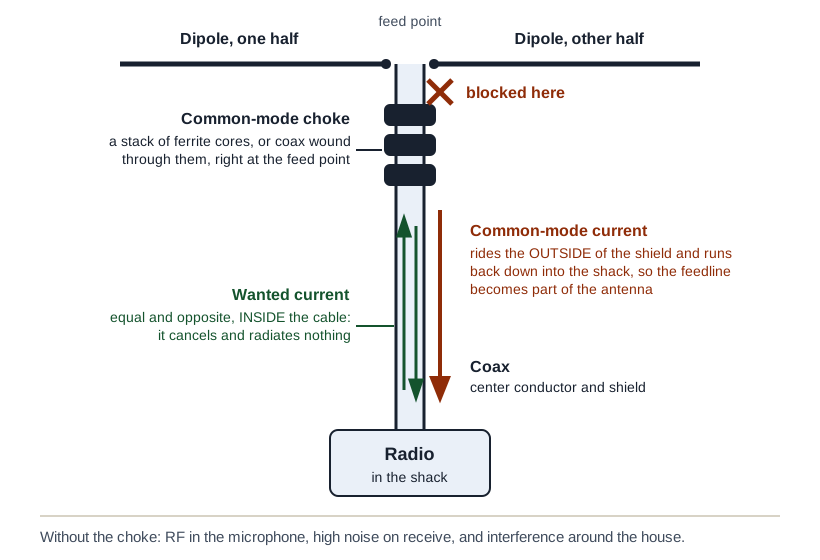
Once it is flowing, your feedline is an antenna running straight into the house. It radiates where you do not want it, it picks up every switching supply and dimmer on the way, and it dumps RF onto the chassis of everything it passes.
What a Choke Actually Does
A common-mode choke presents a high impedance to current on the outside of the shield, while leaving the wanted currents inside the cable untouched. Ferrite does this because it is lossy at radio frequencies: the energy goes into heat in the core instead of down the cable.
A useful HF feedline choke has at least 1,000 ohms of common-mode impedance across the bands you use, and 2,000 to 5,000 ohms is better. One clamp-on bead does not come close; a stack of them, or several turns of coax through a large core, does.
Two ways to build one, both standard:
- Thread the coax through a row of cores — commonly five to ten 2.4-inch 31-material cores in a line, with the coax passing once through each.
- Wind the coax through one large core several times. Fewer turns favor higher bands, more turns favor lower ones, which is why some operators keep one choke for 80 and 40 and another for 20 up.
Put it at the antenna feed point, where the current gets on. A choke at the shack end keeps the RF out of the radio but leaves the whole feedline radiating outside.
Where Else Ferrite Earns Its Keep
| Material | What the maker says it is for | In the shack |
|---|---|---|
| 31 | EMI suppression from as low as 1 MHz up to 500 MHz | The usual choice for HF feedline chokes and for cables carrying HF noise. |
| 43 | Suppression of conducted EMI from 20 MHz to 250 MHz | Good from the higher HF bands through VHF; the classic clamp-on material. |
| 61 | Inductive applications up to 25 MHz; EMI suppression above 200 MHz | Use it for VHF and UHF suppression, or for winding tuned inductors. |
Ranges are Fair-Rite’s own published figures for those materials, checked 25 September 2026. Other makers number their materials differently — match the material, not the number.
The same trick works on any cable that carries noise rather than signal: the DC leads to the radio, a USB or CAT cable to the computer, a rotator control cable, the mains lead of an offending switching supply. Clamp-ons are fine here, and two or three turns of the cable through a clamp-on is far better than one pass.
Finding Out Whether It Worked
You do not need a fancy instrument. Note the receive noise level on a quiet frequency, add the choke, and look again. If a signal report or an SWR reading changes when you touch the radio or the desk, there is still common-mode current. An RF current clamp will show it directly if you own one, and a small loop on a receiver run along the cable will find it well enough if you do not.
The Order to Do Things
Fix the cause before reaching for cures. A well-fed, balanced antenna with a choke at the feed point rarely needs anything else. Chokes on every cable in the house, with no choke at the antenna, is treating symptoms.