Key Points
- Part 97 limits what state and local government may do: their rules must reasonably accommodate amateur antennas (the 1985 PRB-1 ruling).
- That protection does not reach private deed covenants, and the FCC’s over-the-air reception devices rule excludes amateur radio.
- Some associations will approve a hidden wire if asked politely and in writing; if you rent, ask the landlord.
- Four quiet antennas: a wire in the attic, a vertical inside a flagpole, a wire along a fence or gutter, or a thin wire up a tree.
- A remote coupler at the antenna, a choke at the feed point and the digital modes all help a small antenna do more.
A tower and a beam are wonderful, and most of us will never have one. Deed restrictions, a rented apartment, a small lot, an unimpressed spouse: the reasons pile up. None of them has to keep you off the air, and some of the best operators you will hear are working from an attic.
First, What the Rules Actually Say
Two things get muddled constantly, so it is worth being precise about them.
Part 97 does limit what state and local government may do. The rule says a station antenna structure “may be erected at heights and dimensions sufficient to accommodate amateur service communications”, and that state and local regulation “must not preclude amateur service communications. Rather, it must reasonably accommodate such communications and must constitute the minimum practicable regulation to accomplish the state or local authority’s legitimate purpose.” That principle comes from the FCC’s 1985 PRB-1 ruling and is referenced in the rule itself.
That protection applies to city and county rules. It does not reach private deed covenants, and the FCC’s over-the-air reception devices rule does not help either: that rule covers TV, satellite and fixed wireless antennas, and the definition expressly excludes amateur radio.
So a zoning officer and a homeowners’ association board are two very different conversations. Some associations will approve a wire if asked politely and in writing, especially when it is invisible and comes with an offer to take it down on request. It is worth asking before assuming the answer is no. If you are renting, ask the landlord, not the neighbors.
We are not lawyers, and an association’s covenants are a contract you agreed to. If it matters enough to fight, that is a conversation with someone qualified in your state.
Four Antennas That Keep Quiet
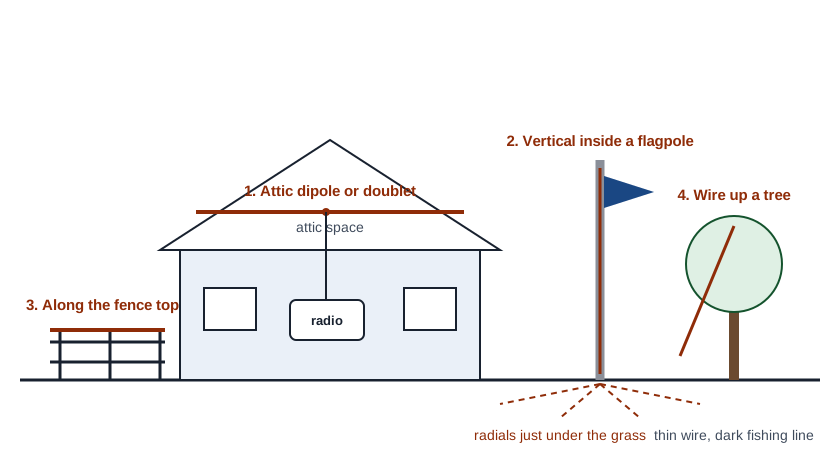
1. In the Attic
A dipole or doublet strung through the roof space works, and nobody outside can see it. Expect to lose some signal in the roofing, more at VHF than HF, and expect the pattern to be shaped by whatever is up there with it. Keep the wire away from house wiring, and keep away from it yourself while transmitting — attic feed points are at head height and RF burns are real. Run less power than you would outside.
2. Inside a Flagpole
A fiberglass flagpole with a wire vertical inside it is the classic answer, and a flag flying from it tends to settle the argument about what it is. Verticals want radials: a set of wires laid out just under the grass works well, and more short radials beat a few long ones.
3. Along a Fence or a Gutter Line
A thin wire along the top of a back fence, or tucked into the shadow of a gutter, disappears at ten paces. It will be low and close to lossy things, so it is no DX machine, but it gets you on the air. Keep it insulated from anything metal and remember a fence is not a ground system.
4. Up a Tree
A length of thin wire hauled into a tree on dark fishing line is nearly invisible, cheap, and quick to take down. Leave slack so the tree can move in the wind; a wire tied tight to two trees breaks in the first gale.
Making a Small Antenna Work Harder
- Use a remote antenna coupler at the antenna instead of a tuner in the shack, so the feedline runs matched and the loss stays low.
- Choke the feedline at the feed point. A compromise antenna is unbalanced by nature, and common-mode current is what puts RF back into the house.
- Aim low in frequency for the nearby stuff and pick your moments on the higher bands: a modest antenna with good propagation beats a big antenna at the wrong time.
- Try the digital modes. FT8 and other weak-signal modes routinely get through with a poor antenna and a few watts where voice will not.
- Consider a magnetic loop. They are small, they can sit indoors or on a balcony, they hear quietly, and their narrow bandwidth means retuning as you move about a band.
The Honest Summary
Hidden antennas trade performance for peace. You will work less DX than the operator with a tower, and you will still work plenty. The alternative — waiting for a house with three acres — is how people leave the hobby before they start.